
From the Mashpee Enterprise, by Lauren Surbey, August 26, 2026
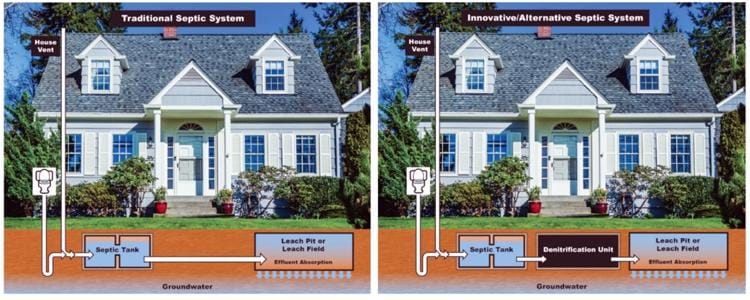
The Board of Health discussed amending Mashpee’s regulation regarding innovative/alternative (I/A) onsite septic systems on August 19.
Health Agent Zackary Seabury said last week that he has been taking “baby steps” on increasing water protection in Mashpee since taking the position in 2022.
The amendments require I/A septic systems to be installed on all new construction. Any upgrades to the system are required to be within the designated “MassDEP Zone II Areas” or within 1,000 feet from “surface waters, freshwaters or coastal wetlands, bordering vegetated wetlands, salt marshes, inland and coastal banks or other resource areas as defined in the Mashpee Board of Health Regulations and Chapter 172 of the Mashpee Code.”
“Right now the I/A regulation requires anything within 1,000 feet of a water body or surface water to be I/A technology; Innovative/Alternative nitrogen removal system up to 19 milligrams per liter,” Seabury told the Board of Health. “In this updated proposal, in the applicability, we’ll also be designating the MassDEP [Department of Environmental Protection] designated Zone II Areas. These are well-protection areas.”
Zone II areas are protected by MassDEP. Mashpee’s Zone II designation requires residents to have no more than one bedroom on 10,000 square feet of property. The only exception is if the home was already built before it became part of the town’s Zone II designation.
“A lot of the Zone IIs in town were created in 1999 when they started doing the water towers and finding out about the plumes for those water towers,” Seabury said. “It is to help protect the groundwater in that.”
The amended regulation would require residents living within 500 square feet of water bodies to remove 11 milligrams per liter or more of total nitrogen.
“A lot of towns are only doing 500 feet. We have 1,000 feet for 19 milligrams per liter,” Seabury said. “I’d like to propose 11 milligrams up to 500 feet, and then [properties] past 500 to 1,000 [feet] and Zone II’s would still need nitrogen removal of 19 milligrams per liter.”
He said he knows that residents will ask why 11 milligrams per liter is a better option.
“The state has required... a system that can release 10 milligrams per liter or better,” he said. “There is only one system out there approved for 10 milligrams per liter or better. There is another system approved for 11 milligrams per liter or better. I didn’t want to pick the 10 milligrams and not give people options. With 11 milligrams per liter, we give people options of what they want to use.”
Seabury said that this is the first of two discussions the Board of Health will have on the regulation amendments.
“We’ll do one more discussion before we take it to a vote,” he said, “to see if any residents come up and say ‘well, let’s just make it 11 to 10 for Zone II’s and for up to 1,000 square feet.’ Then we could add that, and it can be voted on”
Seabury added that new homes are being built within 500 feet of water bodies.
“Because of how our sewering plan is and newer houses are mainly being built within the 500 feet [of a water body], I think these are the best steps forward in the coming I/A technology time.”
Residential homes in the town’s Zone II designation area take up between 40 and 50% of the town, Seabury said.
“There is a lot of that area that is pine trees and conservation land,” he said. “Besides the Santuit Pond area, Zone II is our most condensed area.”
Seabury said several committees are in favor of the amendment.
“I know certain groups of people are waiting for this step to happen,” he said. “They’re asking me to speed it up. But I haven’t told anybody what the plans were. This is the first, besides me writing it, that anybody has seen it written. And then we’ll have another discussion at the next meeting. And then we’ll do the vote.”
The next Board of Health meeting is scheduled for Wednesday, September 2. The board will have a second discussion on the proposed regulation amendments at that time.

Member discussion: